
How EQUIPP Copilot Simplifies Pharmacy Workflows While Supporting STAR Ratings




.png)
Pharmacies are being asked to do more with the same (or fewer) people. Between verifying orders, handling prior authorizations, counseling, and managing vaccines, there is limited time left for quality programs—yet measures tied to adherence, blood pressure control, and diabetes outcomes continue to influence payer contracts and, indirectly, patient access and plan benefits. The problem for most pharmacies is not understanding CMS STAR Ratings or HEDIS; it is acting on them in real time without breaking the workflow.
EQUIPP Copilot is designed to close that gap by bringing quality signals to the point of care, where pharmacists and technicians can do something about them.
The Real Workflow Problem Behind Quality Performance
In a typical community or independent pharmacy, quality work often happens “off to the side” of the main job:
- Someone logs into EQUIPP, payer portals, or health‑plan report cards to see which patients are failing PDC adherence measures for diabetes, RAS antagonists, or statins.
- That list is printed or copied into a spreadsheet.
- During slower moments, staff try to call patients, add notes to profiles, and remember to follow up.
By the time all of that happens, the patient may have switched plans, picked up elsewhere, or simply never shows up. Quality insights arrive, but they do not reliably translate into behavior at drop‑off, verification, or pick‑up.
Day to day, pharmacists and technicians experience quality work as:
- Toggling across multiple systems (dispensing software, payer portals, health‑plan dashboards)
- Re‑identifying the same patients in each system
- Manually tracking who was called, what was discussed, and whether the intervention “counts” for a measure
Those extra steps are exactly where adherence gaps and other STAR measures fall through the cracks.
What EQUIPP Copilot Actually Does in the Pharmacy
Rather than asking pharmacy teams to think in terms of cut points, percentiles, or measure IDs, EQUIPP Copilot focuses on the immediate question at the counter: “Is there anything quality‑related I should address with this patient right now?”
At a practical level, EQUIPP Copilot can be positioned to:
- Surface patient‑level quality opportunities inside the dispensing workflow
- Flags appear when a prescription is being verified or during patient profile review, indicating issues like chronic med PDC at risk, missing statin in diabetes (SUPD), or recent gap in diabetes or blood pressure monitoring, based on payer feeds and quality data.
- Flags appear when a prescription is being verified or during patient profile review, indicating issues like chronic med PDC at risk, missing statin in diabetes (SUPD), or recent gap in diabetes or blood pressure monitoring, based on payer feeds and quality data.
- Prioritize who needs attention today
- Instead of a long static list, the queue shows “patients in front of you” who are within days of falling below adherence thresholds or tied to a high‑impact measure for a specific payer.
- Instead of a long static list, the queue shows “patients in front of you” who are within days of falling below adherence thresholds or tied to a high‑impact measure for a specific payer.
- Guide the type of intervention
- For example: suggest discussing 90‑day fills, synchronization, med packaging, or a quick blood pressure check—interventions pharmacists already know, but timed to when the patient is reachable.
- For example: suggest discussing 90‑day fills, synchronization, med packaging, or a quick blood pressure check—interventions pharmacists already know, but timed to when the patient is reachable.
- Prompt for simple documentation
- After the conversation, the system can prompt staff to select what was done (e.g., “converted to 90‑day fill,” “enrolled in sync,” “refused”), so that downstream payer or STAR program reporting can recognize the intervention where contracts support it.
- After the conversation, the system can prompt staff to select what was done (e.g., “converted to 90‑day fill,” “enrolled in sync,” “refused”), so that downstream payer or STAR program reporting can recognize the intervention where contracts support it.
This is not a replacement for a pharmacy management system. It is a “bridge” layer: taking measure‑level signals and translating them into bite‑sized, patient‑specific tasks that fit naturally into verification, pick‑up, and outreach.
Translating STAR Mechanics into Everyday Pharmacy Actions
From a pharmacist’s perspective, STAR and HEDIS language (e.g., D10, SUPD, CBP, CDC‑H9) becomes manageable when tied to concrete patient situations. EQUIPP Copilot can help by mapping complex quality rules to common moments in the day:
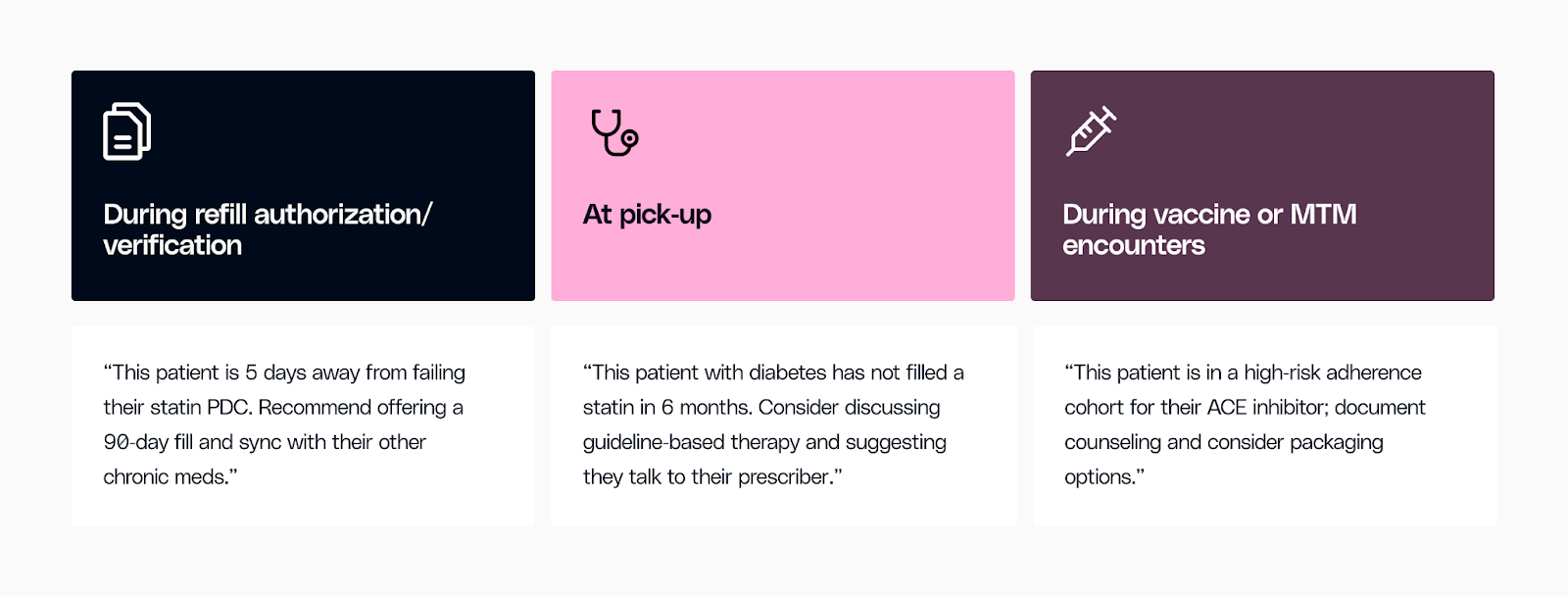
For the pharmacist, the focus stays on clinical conversations and operational levers already under their control (days’ supply, packaging, reminder calls, synchronization), not on memorizing STAR tables or HEDIS specification changes.
How EQUIPP Copilot Fits into a Typical Day
A relatable way to explain the value is to anchor it to the three main pharmacy touchpoints where quality work can realistically happen:
- Flag at Verification
- When a chronic medication is being verified, Copilot flags if the patient is behind on fills relative to their PDC threshold or if they are missing a therapy commonly tied to measures (e.g., statin in diabetes).
- This is the best moment to adjust days’ supply, align fills, or add a note to counsel at pick‑up.
- Talk at Pick‑Up or on the Phone
- When the patient (or caregiver) is present, the system provides a short, pharmacist‑friendly cue: what to bring up and why it matters, in plain language.
- Staff can fold this into the existing counseling script or adherence check, instead of scheduling a separate outreach session.
- Document Without Double Work
- After the interaction, a quick, structured documentation prompt captures what was done so that the activity can support quality reporting and any payer‑specific requirements, where appropriate.
- This minimizes the need to re‑enter the same information later in a different portal or spreadsheet.
This framing speaks directly to how pharmacists think: “Show me the right patient, at the right time, with just enough context to act, and do not add extra clicks.”
If you are considering getting EQUIPP Copilot for your pharmacy, consider signing up for a demo by the EQUIPP team here.